"SD" Specific Details | Macro Photography Session - Technical Description


Hi everyone :)
And another macro photography session.
So we remain resilient, always looking for the next article to keep moving forward.
Right now the focus is on these small rocky gems, and at any moment you can switch to any other random object.
Let's keep going and analyzing one day at a time.
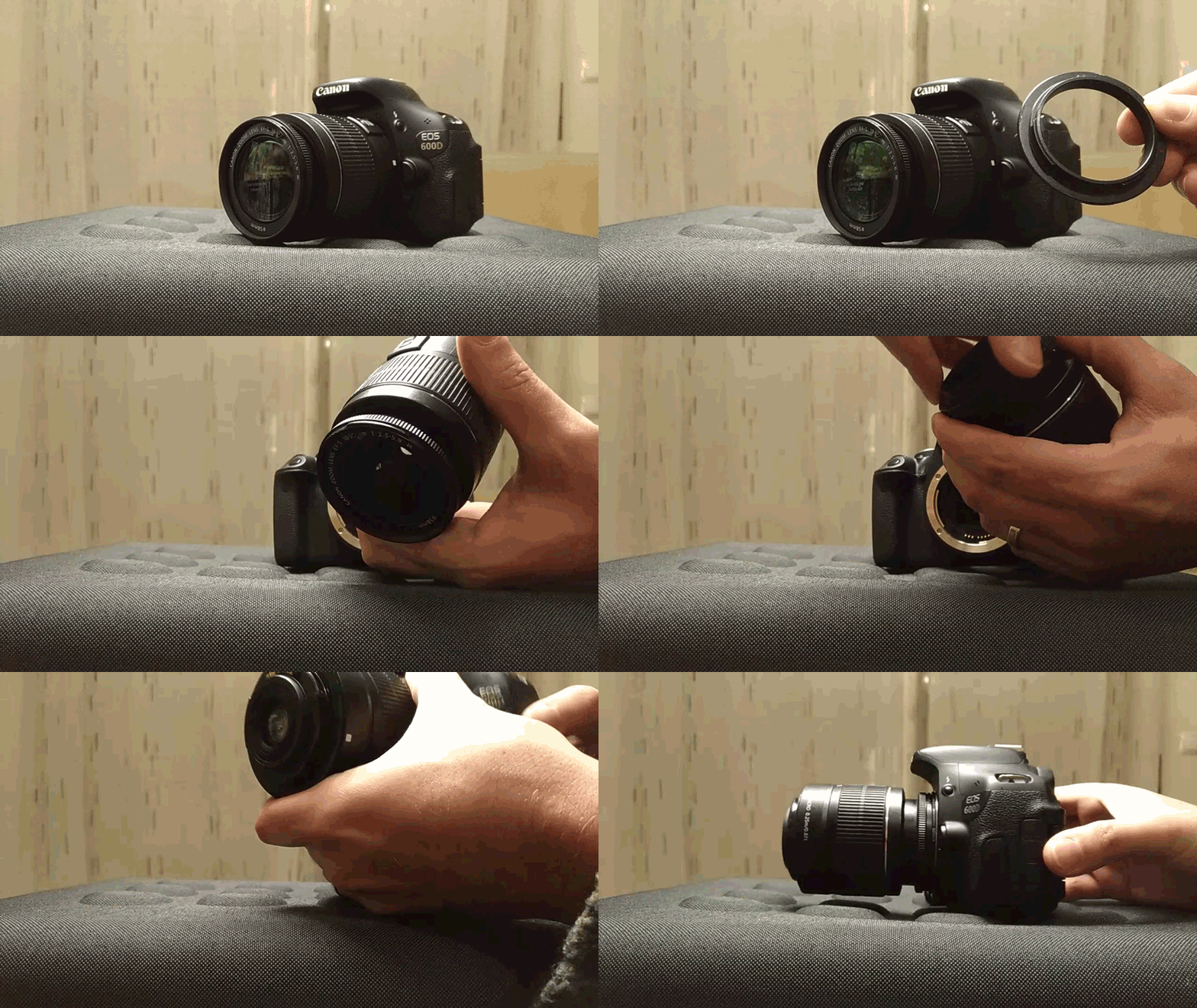
Among the numerous techniques available for macro photography, this method is arguably the most cost-effective and efficient for individuals possessing a camera with a removable lens. By simply detaching the lens and reversing its direction, and employing an inversion ring, the process becomes more manageable and streamlined.
Let me present today’s model:


Session Purpose
The goal of these macro photography sessions is to capture images with as much detail as possible within the capabilities of the technique used, always focusing on the meticulous observation and documentation of all visual characteristics and details. Furthermore, I aim to create attractive visual compositions for publication on this blog, seeking to share the beauty and complexity of this work.
Used equipments
Camera: Canon EOS 600D Digital SLR with CMOS sensor
Lens: EFS 18-55mm with f/5 maximum aperture, allowing shallow depth of field and capturing fine details.
Used inverter ring
Tripod: not used
Lighting: Adjustable LED lights to provide soft, even lighting, avoiding harsh shadows and highlighting the details of structures.
Camera Settings
Focus Mode: Manual focus to ensure precision in specific details of the structure.
Aperture: Variable aperture between f/4 and f/5 for adequate depth of field, ensuring all important details are in focus.
ISO: ISO setting (900)
Shutter Speed: Adjust shutter speed as needed to avoid underexposure, while maintaining a value that allows you to capture sharp details.
To finish, i leave you with some considerations regarding these photo sessions:
Observing all these pieces through macro photography reveals a fascinating dimension and breadth, full of minute details that ultimately assume significant importance in the visual composition. The complexity of these objects, when viewed from this perspective, takes on a beauty that is often overlooked by the indifference of the eye. The essence of macro photography lies in its ability to elevate ordinary objects to extraordinary levels, offering an intimate and captivating perspective.
The session is closed for today.
Hope you like it :)

These photos weren't taken with a tripod
Camera - Canon EOS 600D
Lens - EFS 18-55mm
Location - Portugal

See you soon
Thank you for watching
Never forget
The price of anything is the amount of life you trade for it.
Time is life... value yours, make every fraction worth it.
Congratulations @aleister! You have completed the following achievement on the Hive blockchain And have been rewarded with New badge(s)
Your next payout target is 38000 HP.
The unit is Hive Power equivalent because post and comment rewards can be split into HP and HBD
You can view your badges on your board and compare yourself to others in the Ranking
If you no longer want to receive notifications, reply to this comment with the word
STOPAnother very informative post with excellent results/photos
!DIY
Signal
Type: original post | Authentic: authentic | Importance: notable
Topic: DIY Macro Photography / Reverse Lens Technique
Tags: #photography #technical-description #macro #diy #reverselens
Claim: Reversing a standard kit lens (like the EFS 18-55mm) using an inversion ring is one of the most cost-effective and efficient ways to achieve high-detail macro photography without expensive dedicated lenses.
Stance: support
quote — The author introduces the "Reverse Lens" method, explaining how to detach and flip a lens using an inversion ring to streamline macro shots.
Why it matters: It defines a specific, low-barrier entry point for amateur photographers to explore macro photography using equipment they likely already own.
Posted via First Context