Klasse Gärtnern Auf der Hive Blockchain " ALOE VERA Des Nordens "

Hallo, liebe Hive Gemeinschaft
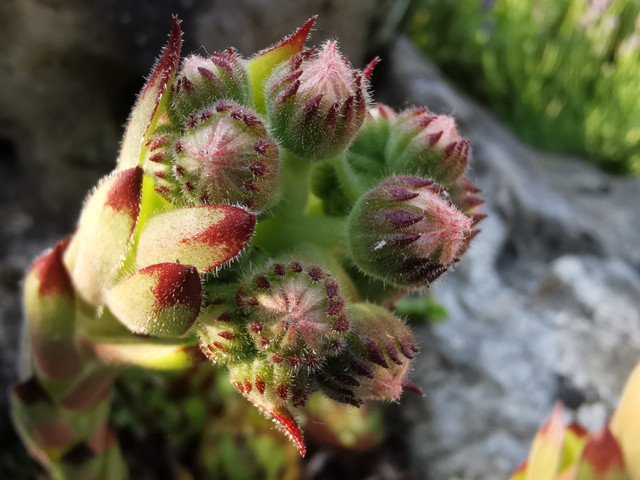
Blütentrieb Im Steingarten
Die Dachwurz (Sempervivum tectorum), auch Dach-Hauswurz genannt, ist das wohl bekannteste Mitglied der Gattung Hauswurz. Sie gehört zur Familie der Dickblattgewächse (Crassulaceae). Ihr Verbreitungsgebiet ist von Europa bis Westasien, wo sie in Mauerfugen und Felsspalten wächst. Bei uns ist sie am häufigsten im Mittelmeerraum anzutreffen. Im Steingarten ist sie in allen Variationen längst ein Klassiker, aber auch bei Dachbegrünungen oft erste Wahl.
In der Überlieferung werden der Dachwurz magische Kräfte zugeschrieben. So galt sie im Mittelalter als sicherer Schutz vor Blitzeinschlägen, worauf auch der heute noch gebräuchliche Name "Donnerwurz" hinweist. Auf Anordnung Karls des Großen sollte sogar jeder Bauer eine solche Pflanze auf seinem Dach haben. Die Dach-Hauswurz hatte aber nicht nur die Funktion eines Blitzableiters, sondern auch die eines Halters von Stroh- und Reetdächern sowie von Mauerkronen und damit durchaus einen praktischen Nutzen.
Man sagte der Pflanze auch eine Wirkung gegen zahlreiche Krankheiten nach. Einen Tee aus Sempervivum tectorum empfahl schon Pfarrer Kneipp bei Magengeschwüren, Übelkeit und zur Blutreinigung. Noch heute ist die "Aloe des Nordens" eine beliebte Heilpflanze, deren Frischsaft kühlend, schmerzstillend, entzündungshemmend und wundheilend wirkt.

Hello, dear Hive community
Flowering shoot In rock garden
Rooftop houseleek (Sempervivum tectorum), also called rooftop houseleek, is probably the best known member of the genus houseleek. Sie gehört zur Familie der Thick-leaf plants (Crassulaceae). Its distribution area is from Europe to Western Asia, where it grows in wall joints and rock crevices. Here it is most often found in the Mediterranean region. In rock gardens it has long been a classic in all its variations, but it is also often the first choice for green roofs.
In tradition, magic powers are attributed to the roofwort. In the Middle Ages, for example, it was considered a sure protection against lightning strikes, which is also indicated by the name "thunderwort" still in use today. By order of Charlemagne, every farmer was even supposed to have such a plant on his roof. However, the roof houseleek had not only the function of a lightning conductor, but also that of a holder of thatched and thatched roofs as well as of wall crowns and thus definitely had a practical use.
The plant was also said to have an effect against numerous diseases. A tea made from Sempervivum tectorum was already recommended by Pastor Kneipp for stomach ulcers, nausea and for blood purification. Even today, the "Aloe of the North" is a popular medicinal plant whose fresh juice has cooling, analgesic, anti-inflammatory and wound-healing effects.
Follow @lichtblick
Yeah, that kind of plant is known as aloe Vera and really its very important and helpful as a herbal medicine as different issues. Its a nature gift and we should protect and nursing properly.
Thank you :-)