A walk along the shore in the eastern part of Venice's old town
Hello to all travelers!
Everyone has probably heard of Venice, seen it in photos or videos. Every so often, there's a new post on Hive about a trip to this city. The Old Town is primarily associated with canals and gondolas. But just like any other city, Venice can be explored simply by strolling along the sidewalks. There are various squares and narrow streets. Today, I invite you for a short walk along the waterfront in the eastern part of the Old Town.
If you've been to Piazza San Marco and head from that square to the Grand Canal, you'll come to the bank called "Riva degli Schiavoni." The rest of your walk will be along this bank to the east.
[ PL ]
Witam wszystkich podróżników!
Chyba każdy słyszał o takim mieście jak Wenecja, widział na zdjęciach czy filmach. Co jakiś czas jest też jakiś nowy post na Hive z podróży do tego miasta. Stare miasto kojarzone jest przede wszystkim z kanałów i gondoli. Ale tak jak każde inne miasto, tak i Wenecję można normalnie zwiedzać spacerując chodnikami. Są tu różne place oraz wąskie uliczki. Dziś zapraszam na mały spacer wzdłuż nabrzeża we wschodniej części starego miasta.
Jeśli ktoś był na Piazza San Marco i z tego placu skieruje się nad Grand Canal to trafi na brzeg o nazwie "Riva degli Schiavoni". Dalszy spacer będzie właśnie wzdłuż tego brzegu w kierunku wschodnim.

Looking south from this shore, we can admire this view. On the island of San Giorgio Maggiore, the distinctive features include a bell tower and the church of the same name. The basilica was built at the turn of the 16th and 17th centuries.
Spoglądając z tego brzegu w kierunku południowym możemy podziwiać taki widok. Na wyspie San Giorgio Maggiore wyróżnia się dzwonnica oraz kościół o tej samie nazwie. Bazylika powstała na przełomie XVI i XVII wieku.

Continuing along this shore, we come across the Monument to Victor Emmanuel II, the first king of united Italy. Many Italian cities boast monuments to this king. The one in Venice was made of bronze in 1887. The entire description of the monument fragments below is quoted from Wikipedia
Idąc dalej tym brzegiem trafiamy na Pomnik Wiktora Emanuela II, czyli pierwszego króla zjednoczonych Włoch. W wielu włoskich miastach znajdziemy pomnik tego króla. Ten w Wenecji powstał z brązu w 1887 roku. Cały poniższy opis fragmentów pomnika cytuję z Wikipedii

At the foot of the monument, in a frontal position, lie two allegories of the city.
U stóp pomnika, w pozycji frontalnej, znajdują się dwie alegorie miasta.

On the sides of the pink granite pedestal, on the long side, two lateral high reliefs are two scenes risorgimento. On the one hand the famous battle of Palestro, fought on 30 and 31 May 1859, during the second war of Italian independence, the first victory of the Franco-Piedmontese army over the Austrian troops; the Crusader shield of House of Savoy is placed on the steps below; On the opposite side is the triumphal entry of Vittorio Emanuele II into Venice finally freed from the Austrian rule, which took place on November 7, 1866, following the Veneto plebiscite of October 21–22, 1866. On the steps below is a shield with the symbols of Rome (a capitolian she-wolf and the initials SPQR).
Po bokach różowego granitowego cokołu, na dłuższym boku, znajdują się dwie boczne płaskorzeźby przedstawiające dwie sceny risorgimento. Z jednej strony słynna bitwa pod Palestro, stoczona 30 i 31 maja 1859 roku, podczas drugiej wojny o niepodległość Włoch, pierwsze zwycięstwo armii francusko-piemonckiej nad wojskami austriackimi; Na stopniach poniżej umieszczono tarczę krzyżowców z dynastii sabaudzkiej; po przeciwnej stronie znajduje się triumfalny wjazd Wiktora Emanuela II do Wenecji, ostatecznie wyzwolonej spod panowania austriackiego, który miał miejsce 7 listopada 1866 roku, po plebiscycie w Wenecji Euganejskiej, który odbył się 21–22 października 1866 roku. Na stopniach poniżej znajduje się tarcza z symbolami Rzymu (wilczycą kapitolińską i inicjałami SPQR).

On the back there is the seated female figure of "Subjugated Venice", battered and prisoner following the defeat suffered by the young Republic of San Marco (1848–1849), holding a broken sword and at the feet a Marcian lion biting the chains imposed by Austria. On the front, there is the personification of "Venice triumphant", this time proud of its regained freedom, with its left arm stretched forward and a sword at rest in its right hand, flanked by a roaring Marcian lion who, while tears up the treaty of Vienna of 1815, places its left forepaw on a plaque with the electoral results of the plebiscite of the Veneto of 1866 (641,758 votes for yes and 69 votes for no), placed in turn on the book with the traditional inscription "Pax Tibi Marce/Evangelista Meus".
Z tyłu znajduje się siedząca postać kobieca „Podbitej Wenecji”, poobijana i uwięziona po klęsce poniesionej przez młodą Republikę San Marco (1848–1849), trzymająca złamany miecz, a u stóp lew marcjański gryzący łańcuchy nałożone przez Austrię. Na awersie znajduje się personifikacja „Wenecji triumfującej”, tym razem dumnej z odzyskanej wolności, z wyciągniętą do przodu lewą ręką i mieczem spoczywającym w prawej dłoni, flankowana przez ryczącego lwa marcjańskiego, który, drzejąc traktat wiedeński z 1815 roku, kładzie lewą przednią łapę na tablicy z wynikami plebiscytu Veneto z 1866 roku (641 758 głosów „tak” i 69 „nie”), umieszczonej z kolei na księdze z tradycyjnym napisem „Pax Tibi Marce/Evangelista Meus”.

After walking around the monument, we continued on our way, passing the Rio dei Greci canal along the way. I took this photo from the Ponte de la Pietà bridge, with the leaning tower of the Orthodox Church of San Giorgio dei Greci visible in the background. So, Pisa isn't the only city with a leaning tower ;)
Po obejściu pomnika dookoła ruszyliśmy dalej, po drodze mijamy kanał Rio dei Greci. Zdjęcie wykonałem z mostu Ponte de la Pietà, w tle widać pochyloną wieżę prawosławnego kościoła San Giorgio dei Greci. Tak więc nie tylko w Pizie znajdziemy krzywą wieżę ;)

On the shore we're walking along, there's another church: the Church of Santa Maria della Pietà. It was built between 1745 and 1760.
Natomiast na brzegu którym spacerujemy znajduje się inny kościół, mianowicie Kościół Santa Maria della Pietà. Został wzniesiony w latach 1745-1760.

Continuing on, we pass another canal, the Rio de la Pieta. In the photo, you can see a small bridge, the Ponte drio La Pietà.
Idąc dalej mijamy kolejny kanał Rio de la Pieta. Na zdjęciu można zauważ mały most Ponte drio La Pietà.

Various stalls line practically the entire length of the Riva degli Schiavoni. You'll also find a variety of restaurants here.
Praktycznie wzdłuż całego brzegu Riva degli Schiavoni rozstawione są rozmaite stragany. Znajdziemy tu również różne restauracje.

After crossing another bridge, Riva degli Schiavoni becomes Riva Ca' di Dio. Here, there are no more stalls and no more crowds.
Natomiast po przejściu kolejnego mostu Riva degli Schiavoni zmienia się w Riva Ca' di Dio. Tutaj już nie ma straganów i nie ma tłumów ludzi.

This one small bridge changes the urban landscape in a sense.
Ten jeden mały most zmienia w pewnym sensie zmienia miejski krajobraz.

After a while we reach another bridge, Ponte San Biasio delle Catene, over the Rio dell'Arsenale canal.
Po chwili dochodzimy do kolejnego mostu Ponte San Biasio delle Catene nad kanałem Rio dell'Arsenale.
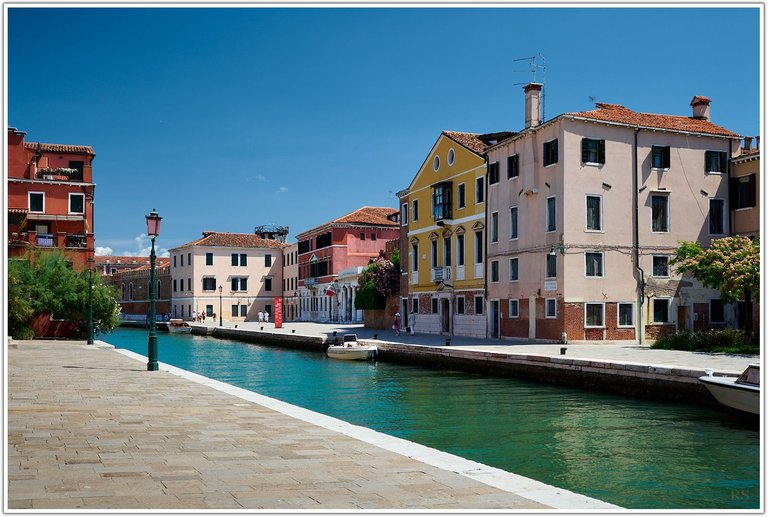
Two photos overlooking the Rio dell'Arsenale canal. The sidewalks here are virtually empty, with only a few people occasionally passing by.
Dwa zdjęcia z widokiem na kanał Rio dell'Arsenale. Tutaj są właściwie puste chodniki, tylko kilka osób czasem przejdzie.

In the background, you can see the tower of the Arsenale di Venezia, a shipyard founded in the early 12th century. Our next walk will take us in that direction, but that will be in another story about this city.
W tle widać wieżę Arsenale di Venezia, czyli stoczni założonej na początku XII wieku. Nasz dalszy spacer będzie odbywał się właśnie w tamtym kierunku, ale to już będzie w innej historii z tego miasta.

To conclude this one, here's another shot taken after crossing the Ponte San Biasio delle Catene bridge. On the left is the Naval History Museum ("Museo Storico Navale"), and straight ahead is the Church of San Biagio Bishop ("Chiesa di San Biagio Vescovo") and the Hotel Bucintoro.
Na koniec obecnej jeszcze jedno ujęcie wykonane po przejściu mostu Ponte San Biasio delle Catene. Po lewej stronie znajduje się Muzeum Historii marynarki Wojennej ("Museo Storico Navale"), natomiast na wprost Kościół San Biagio Bishop ("Chiesa di San Biagio Vescovo") oraz Hotel Bucintoro.
Thanks for your visit and any likes and comments.
Dzięki za wizytę oraz ewentualne polubienia i komentarze.
All photos are my own.
Camera: Nikon Z6II
Lens: Nikkor Z 24-120 f/4
Editing: Capture One
You can check out this post and your own profile on the map. Be part of the Worldmappin Community and join our Discord Channel to get in touch with other travelers, ask questions or just be updated on our latest features.
great adventure! I would also like to visit Venice! Maybe this will also be my bucket list.
YEAH!... Top class article and shots @rsphotos friend!!!
!discovery
!PIZZA
This post was shared and voted inside the discord by the curators team of discovery-it
Join our Community and follow our Curation Trail
Discovery-it is also a Witness, vote for us here
Delegate to us for passive income. Check our 80% fee-back Program
$PIZZA slices delivered:
@jlinaresp(8/15) tipped @rsphotos
Join us in Discord!
Hiya, @glecerioberto here, just swinging by to let you know that this post made it into our Honorable Mentions in Travel Digest #2755.
Your post has been manually curated by the @worldmappin team. If you like what we're doing, please drop by to check out all the rest of today's great posts and consider supporting other authors like yourself and us so we can keep the project going!
Become part of our travel community:
https://www.reddit.com/r/landscape/comments/1p815lb/a_walk_along_the_shore_in_the_eastern_part_of/
This post has been shared on Reddit by @equipodelta through the HivePosh initiative.