Catedral-Basílica del Pilar de Zaragoza // Cathedral-Basilica of the Pillar of Zaragoza


Click here to read this post in English

Hola querido hiver.
Tenía muchas ganas de hacer una visita al monumento más importante de Zaragoza con el tiempo necesario para fotografiarlo. He compartido en este blog lugares cercanos y lejanos pero no había dedicado hasta ahora un post exclusivo a la Catedral-Basílica del Pilar.
Según cuenta la tradición, la Virgen María se apareció en carne mortal al Apóstol Santiago, que andaba predicando por estas tierras en el siglo I. Desde entonces siempre ha habido una capilla que ha sido respetada por otras religiones que dominaron posteriormente la zona y que tras diversas reconstrucciones y rehabilitaciones ha llegado hasta lo que conocemos hoy.
Si quieres ampliar los datos que iré comentando a lo largo de la publicación, tienes toda la información en la web del Cabildo zaragozano.


La mayoría de los visitantes entramos por la conocida como Puerta Baja, la situada más al sur y orientada hacia la plaza del Pilar. Nada más franquear la puerta nos llamará la atención la capilla del Cristo de los Milagros, una talla de madera que recibe mucha devoción de los fieles y que hace unos años tuvo que ser protegida por una mampara para frenar su deterioro tras miles y miles de besos y caricias en sus pies.
El siguiente movimiento es asomarse a la Santa Capilla, que acoge la talla de Nuestra Señora del Pilar. Los que la ven por primera vez siempre se sorprenden de que la figura sea tan pequeña de tamaño, solo 36 centímetros. Es de madera, está colocada sobre su famoso Pilar forrado en plata y cubierto éste con sus característico manto, que cambia según los días o celebraciones.
También llamarán la atención de los visitantes los lujosos halos que rodean su cabeza y las 72 estrellas que cubren la pared del camarín. Todo son piezas donadas por los fieles a lo largo de los siglos, por lo que tienen un valor incalculable que va más allá de lo económico.
Un dato curioso es que junto a la Santa Capilla cuelgan un par de bombas que cayeron sobre el templo durante la Guerra Civil y que no estallaron. Uno de los agujeros que hicieron en la estructura sigue visible. Además, en las paredes de esta parte cuelgan banderas de los países que conforman Hispanoamérica, ya que la Virgen del Pilar está considerada la patrona de la Hispanidad.


La Santa Capilla es como un templo dentro de otro templo. Es una construcción independiente del resto del edificio, obra del arquitecto Ventura Rodríguez, quien también realizó la Capilla del Palacio Real en Madrid. Es de estilo barroco y todos sus elementos se orientan hacia la imagen de la Virgen del Pilar, que está situada en un lado para no mover su localización original.


Una capilla que ha sido restaurada recientemente es la de Santiago. Esta era la primera vez que la veía con todo su esplendor. Todo el templo está siendo mejorado con vistas a la celebración del bimilenario de la venida de la Virgen en 2040. Puede parecer que quedan muchos años aún, pero en un monumento de esta envergadura y para no cerrarlo al público hay que ir poco a poco.


Un rincón que puede pasar desapercibido es la sacristía de la Virgen. En unos grandes armarios se custodia la gran colección de mantos que tiene la imagen. Antes se llevaban a los fieles enfermos con la esperanza de que les curase. Cuando la demanda aumentó de forma que lo hacía inviable, se ideó como solución alternativa la elaboración de unas cintas cuya medida era exacta a la que tiene la talla.
La referencia más antigua a estas cintas se remonta al siglo XVII. Los derechos de su venta son exclusivos del Cabildo Metropolitano, por lo que solamente se pueden comprar en el templo. La demanda es tal que se pueden comprar hasta en unas máquinas automáticas. La tradición no está reñida con la modernidad, jeje.


Otro punto de interés es la cúpula que pintó Francisco de Goya. Su Regina Martyrum no fue entendida en aquellos momentos por quienes la encargaron, pero es una obra maestra. También fue restaurada hace unos años.


Hacemos otra parada en el pequeño hueco donde se puede besar el pilar que sostiene la talla de la Virgen, situado en su parte trasera. Este punto es menos conocido por los turistas, ya que está poco destacado, pero como la fila es casi permanente es inevitable que se pregunten lo que hay ahí.
Este día tuve la oportunidad e hacer una fotografía desde la puerta del Museo Pilarista. Es el lugar donde se custodian y exponen las joyas donadas por los fieles. La visita a esta parte es bajo pago.


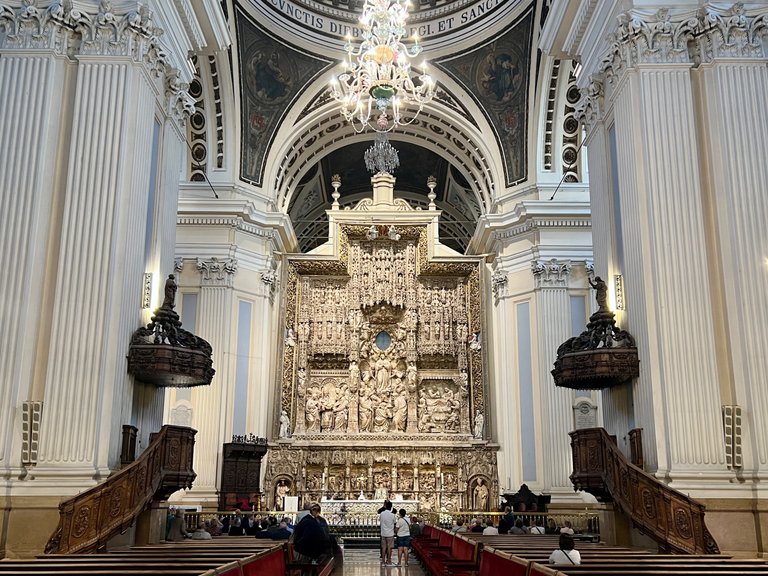
El siguiente punto de interés es el fabuloso retablo del altar mayor de la catedral-basílica. Su autor es Damián Forment, quien lo esculpió en alabastro, un material abundante y muy utilizado en la zona. En sus orígenes estaba policromado pero apenas quedan restos en su parte inferior.


Imagínate que los pocos colores que ves cubren por completo el retablo y entenderás por qué se considera una joya escultórica.


Frente al altar mayor, en el extremo norte del templo, se sitúan el coro de estilo plateresco y el órgano. Ambos proceden de la época gótica y se mantuvieron en la restauración de estilo neoclásico.


Tomé algunas imágenes más desde esta zona antes de abandonar el Pilar. Se aproximaba la hora del atardecer, por lo que antes de regresar a casa me acerqué al Puente de Piedra para atrapar una vez más una de las vistas más bonitas de nuestra ciudad.


Hasta la próxima publicación. Mientras tanto, ¡cuídate!

Herramientas: Cámara iPhone 13 Pro, editor de fotos Mac.
Mis publicaciones en Worldmappin pinchando aquí
Si te gusta lo que publico, únete a mi Fanbase pinchando aquí

©️Copyright 2025 Paloma Peña Pérez. Todos los derechos reservados.

Hi, dear hiver.
I was eager to visit Zaragoza's most important monument and take the time to photograph it. I have shared places near and far on this blog, but until now I had not dedicated an exclusive post to the Cathedral-Basilica of El Pilar.
According to tradition, the Virgin Mary appeared in mortal form to the Apostle James, who was preaching in these lands in the 1st century. Since then, there has always been a chapel that has been respected by other religions that later dominated the area and, after various reconstructions and renovations, has become what we know today.
If you would like more information about what I will be discussing throughout this post, you can find everything you need on the website of the Zaragoza Cathedral Chapter.
Most visitors enter through the Puerta Baja, the southernmost gate facing the Plaza del Pilar. As soon as we pass through the gate, our attention is drawn to the Chapel of Cristo de los Milagros, a wooden carving that is greatly revered by the faithful and which, a few years ago, had to be protected by a screen to slow its deterioration after thousands and thousands of kisses and caresses on its feet.
The next stop is the Holy Chapel, which houses the carving of Our Lady of Pilar. Those who see it for the first time are always surprised that the figure is so small, only 36 centimetres tall. It is made of wood and stands on its famous silver-covered pillar, which is covered with its characteristic mantle, which changes depending on the day or celebration.
Visitors will also be struck by the luxurious halos surrounding her head and the 72 stars covering the wall of the dressing room. All of these pieces have been donated by the faithful over the centuries, so they have an incalculable value that goes beyond the economic.
An interesting fact is that next to the Holy Chapel hang a pair of bombs that fell on the temple during the Civil War and did not explode. One of the holes they made in the structure is still visible. In addition, the walls of this part are decorated with flags of the countries that make up Spanish America, as the Virgin of Pilar is considered the patron saint of Hispanic culture.
The Holy Chapel is like a temple within another temple. It is a separate structure from the rest of the building, designed by architect Ventura Rodríguez, who also designed the Chapel of the Royal Palace in Madrid. It is Baroque in style and all its elements are oriented towards the image of the Virgin of Pilar, which is located on one side so as not to move its original location.
One chapel that has been recently restored is that of Santiago. This was the first time I had seen it in all its splendour. The entire temple is being improved in preparation for the celebration of the two thousandth anniversary of the arrival of the Virgin in 2040. It may seem like there are still many years to go, but with a monument of this magnitude, and in order not to close it to the public, it is necessary to proceed gradually.
One corner that can easily go unnoticed is the sacristy of the Virgin. Large cabinets house the extensive collection of mantles belonging to the image. In the past, these were taken to the sick faithful in the hope that they would be cured. When demand increased to such an extent that this became unfeasible, an alternative solution was devised: ribbons were made to the exact measurements of the carving.
The oldest reference to these ribbons dates back to the 17th century. The rights to sell them are exclusive to the Metropolitan Council, so they can only be purchased in the temple. Demand is so high that they can even be bought from vending machines. Tradition is not at odds with modernity, hehe.
Another point of interest is the dome painted by Francisco de Goya. His Regina Martyrum was not understood at the time by those who commissioned it, but it is a masterpiece. It was also restored a few years ago.
We make another stop at the small niche where you can kiss the pillar that supports the statue of the Virgin Mary, located at the back. This spot is less well known to tourists, as it is not very prominent, but as there is almost always a queue, it is inevitable that they will wonder what is there.
On this day, I had the opportunity to take a photograph from the door of the Pilarista Museum. This is where the jewels donated by the faithful are kept and displayed. There is an admission fee to visit this part of the museum.
The next point of interest is the fabulous altarpiece of the main altar of the cathedral-basilica. Its author is Damián Forment, who sculpted it in alabaster, a material that is abundant and widely used in the area. It was originally polychromed, but only a few traces remain on the lower part.
Imagine that the few colours you see completely cover the altarpiece and you will understand why it is considered a sculptural gem.
Opposite the high altar, at the north end of the church, are the Plateresque choir and the organ. Both date from the Gothic period and were retained during the Neoclassical restoration.
I took a few more pictures from this area before leaving Pilar. Sunset was approaching, so before heading home, I went to the Stone Bridge to capture one of the most beautiful views of our city once again.
Until the next post. In the meantime, take care!
Tools: iPhone 13 Pro camera, Mac photo editor.
Translated with DeepL
My publications in Worldmappin by clicking here
If you like my content, join my Fanbase clicking here
©️Copyright 2025 Paloma Peña Pérez. All rights reserved.
You can check out this post and your own profile on the map. Be part of the Worldmappin Community and join our Discord Channel to get in touch with other travelers, ask questions or just be updated on our latest features.
Thanks for the pin. 📍🤗
Hey @palomap3 you are welcome.
Thanks for using @worldmappin 😘
Good morning, dear friend @palomap3
I'm so glad you were finally able to visit the Basilica of Our Lady of the Pillar and share this architectural beauty with us.
The entire interior is truly beautiful, a real work of art. I loved all the altars and their beautifully decorated domes.
Excellent photos! You let us see the exquisite details of this gorgeous cathedral.
Have a wonderful day!
This temple is known all over the world. Anyway, my opinion is totally subjective, the people of Zaragoza have a lot of devotion to the Virgen del Pilar, whether we are believers or not. I'm glad you liked it, thank you for the support. Have a great weekend, dear.
We appreciate your work and your publication has been hand selected by the geography curation team on behalf of the Amazing Nature AN Community. Keep up the good work!
This post has been manually curated by @bhattg from Indiaunited community. Join us on our Discord Server.
Do you know that you can earn a passive income by delegating to @indiaunited. We share more than 100 % of the curation rewards with the delegators in the form of IUC tokens. HP delegators and IUC token holders also get upto 20% additional vote weight.
Here are some handy links for delegations: 100HP, 250HP, 500HP, 1000HP.
100% of the rewards from this comment goes to the curator for their manual curation efforts. Please encourage the curator @bhattg by upvoting this comment and support the community by voting the posts made by @indiaunited.
Oh amiga @palomap3 me ha encantado conocer esta basílica, es preciosa, disfruté cada foto y me imaginé visitándola y viéndola con mis ojos. El retablo del altar es una obra de arte de gran valor, lo amé. Gracias por traernos esta joya de Zaragoza. Un abrazo 🤗
Los zaragozanos estamos muy orgullosos de nuestra patrona, ya desde bebés hay costumbre de presentarnos a la Virgen. Hasta los que no son creyentes la defienden, jeje. El Pilar es una seña de identidad para nosotros, me hace feliz saber que te gustó verlo por dentro. ¡Gracias!
Wonderful church!
Thank you. ☺️
Hola @palomap3 👋🏾 menudo viaje a través de éstas fotos, son increíbles. La belleza de esta arquitectura es indiscutible, tengo un amigo cubano que vive en Zaragoza y me contó de esta Catedral cuando fue a visitarla, quedó prendado. Por supuesto, una cosa es verla por fotos y otra muy distinta estar ahí. Espero poder llegarme algún día 🙏🏾💙 Saludos
Oh, pues sí, ojalá que algún día lo puedas visitar. Tienes razón, las fotografías no sustituyen una experiencia en persona pero al menos he podido acercarte el lugar más querido por los que vivimos en Zaragoza. Me alegro de saber que tu amigo te habló de él. Los aragoneses somos muy acogedores, espero que se encuentre bien entre nosotros. 😁 ¡Un abrazo!
Waooo!! @palomap3 que belleza de Basílica 🤩😍!!
Te diré que la Cathedral de La habana es bonita pero nunca había visto tantas pinturas, esculturas, arquitectura de mármol todo es espectacular en tu post y visita. La Virgen del Pilar de Zaragoza debe ser bien atractivo de conocer, más su fachada que me gusto tu ultima foto la guarde en mi galería, la parte del museo pilar es impresionante las obras de oros activas, con su estilo neoclasico siempre amo estos tipos de joyas.
Saludos Paloma, excelente contenido y feliz día para ti !! 🤗☺️🙏
!HOPE
Si lo que más te llama la atención son las pinturas, esculturas y mármoles, te cuento que a unos metros del Pilar tenemos otra catedral, la de San Salvador, que es mucho más espectacular y rica en adornos. Pero el Pilar es el Pilar, famoso en todo el mundo, jeje. Un día haré la visita del museo para ver esas joyas de cerca.
Qué bonito que hayas guardado la foto, los atardeceres ahí son preciosos. Muchas gracias por apreciarlo, un abrazo. 🤗
Pues si @palomap3, cada vez que hagas algún post de galerías, arte, esculturas o bueno arte en general, no dudes en que me va a encantar ver el post.
Aunque se que muchas veces con el trabajo y demás no reviso los contenidos, pero si me etiquetas estaría súper contento de verlos.
Te diré que la catedral de Pilar es bellísima. Me encanto !! 😍👏
No me gusta etiquetar si no es necesario, cuando te apetezca puedes mirar mi perfil y elegir al gusto, jaja. Igual agradezco la visita aunque ya no haya recompensas que recibir. 😘
mi Dios bendito necesito decir algo jajajaja pero no se si me van a odiar... tanto oro... jjajajajjaja
Hay mucho dorado pero no todo es oro, jajaja. Ese lo guardan en el museo, algún día haré la visita y cuando lo publique aquí entonces sí que vas a alucinar. 🤣
La virgen será pequeña, pero veo que la edificación es grande y muy decorada.. bellezas de esculturas y relieves, asi como la pintura de Goya, no sabía que el realizó este tipo de obra....y esa imagen desde lo lejos al atardecer es una Belleza!
Mucha gente se sorprende cuando descubren que apenas se ve la imagen, jeje. Goya pintó al fresco en varios templos de la zona. Esta cúpula le trajo discusiones con su cuñado y con los canónigos de la basílica, tanto que en cuanto la terminó se marchó para Madrid muy enfadado. No encajaba con el arte de su tiempo, como tantos otros genios era un adelantado incomprendido. Los atardeceres en ese punto son los más bonitos de la ciudad. 😊
You have been manual curated and upvoted by @ecency
Did you know that @stresskiller is also a witness now ?
Thank you! ☺️
Super bello lugar!
I learned some great information, it's really surprising that such a small statue is only 36 centimeters long and has so much valuable history in such a small thing.
You're right, in fact visitors are always surprised when they see it for the first time. They don't expect it to be so small, haha. I'm glad you learned something new, thank you!
¡Madre mía, qué hermosas imágenes!
Gracias, @palomap3
Me alegro de que te hayan gustado, un abrazo.
Gracias!!!!
Me encanta esta catedral, su estructura y detalles son maravillosos y majestuosos. Sin duda alguna una obra digna de visitar.
Gracias por recorrerla conmigo, me alegro de que te haya gustado. 🤗
Todavía me acuerdo del día cuando visitamos la Catedral del Pilar contigo 😇 y de las explicaciones con las que nos ayudaste a conocer mejor a este magnífico sitio. Las bombas que cayeron y no estallaron - para mí siguen siendo un misterio y milagro!
Cómo olvidar ese día, fuisteis mis primeras víctimas en persona de Hive. 🤣
Lo de las bombas no fue tan milagroso, al menos según la teoría más reciente. (En resumen, que iban vacías) Aunque siempre es más estimulante pensar que hubo algo místico.
Espero que hayas tenido un buen puente. 😘
Jajaja, las primeras víctimas 😂
Bueno, vacías o no, lo importante es que la basílica sigue allí 😉
Sí, tenemos un puente muy bueno: el sábado fuimos a Valencia ✨️, luego el domingo trabajo como siempre jajaja y hoy muy tranquilitos en casa. Espero tú también pasaste un buen finde y puente 🤗
Si trabajaste el domingo eso no es un puente. 😤 Seguro que la visita a Valencia lo compensó. 🥰
Beautiful architecture and paintings!!
Thank you.
Hello @palomap3 I thank you for sharing this experience to us. The Cathedral-Basilica of the Pillar of Zaragoza looks overwhelming to me but majestic. The details are so comprehensive, from the exterior to interior, with all histories embedded on them. Upon looking at the striking appearance of the Cathedral and the stone bridge humbles me that I feel like I don't have the right to describe it. Such an amazing, perfect, and historical place that carries a lot of notes and relevance. I hope you enjoyed the visit there. I will wait for your next stop❤️
I'm very happy that you found out through my post. It is as you say, a great monument that impresses even if you are not a believer. It's artistic everywhere. ☺️
Congratulations @palomap3! You received a personal badge!
You can view your badges on your board and compare yourself to others in the Ranking
Check out our last posts:
🤣 Thank you!!
Awesome job @palomap3! You're a true champion on Hive. Keep the buzz alive!
Wow the cathedral looks so grand both inside and outside! Nicely taken photos!
Thank you!
Saludos, es realmente una joya arquitectónica, un monumento histórico
Así es, Zaragoza tiene dos milenios de historia para mostrar.
Thank you for sharing this beautiful basilica our lady of pillar. Nice place. I love also going to different place. Hoping to read more of your vlogs.
I'm glad you liked it, thank you!
https://www.reddit.com/r/travelpictures/comments/1q4vvs2/cathedralbasilica_of_the_pillar_zaragoza_spain_oc/
This post has been shared on Reddit by @palomap3 through the HivePosh initiative.