Let's visit Oyama Shrine 尾山神社 👹🍣🎎 Wonderful Japan

There are many reasons to stay a little longer in Japan. One is the food, which I have already reported on many times here, and another is the country's impressive variety of landscapes. From expansive coastlines to majestic mountains to endless forests and vast rice fields, each season has its own unique charm. And last but not least, there are the numerous temples and shrines that can be found in every corner of the country.
And it is precisely these spiritual places that I find particularly appealing. Even though I am not religious myself, I cannot escape the quiet, almost tangible atmosphere that surrounds you there. And it is probably this subtle, mystical aura that tempts me time and again on my travels and excursions to visit temples and shrines that I don't yet know. And often enough, I find myself returning a second time, and in some cases even again and again.
So it came to pass that during our last visit to Kanazawa, I decided to plan our trip so that we could visit a shrine that I had already seen on a previous occasion.
Kanazawa itself is a really interesting city and definitely worth a visit. Located on the west coast of Japan in Ishikawa Prefecture, it was once the seat of the powerful Maeda clan. Over the centuries, they developed the city into a cultural center that rivaled even Kyoto. Kanazawa was once the center of the surrounding Kaga region, which during the Edo period was one of the richest principalities in the country.
Luck, coincidence, and cleverness guided the city through the changing times without major destruction, allowing it to survive even the Boshin War and World War II without significant damage. Today, you will encounter a rare blend of samurai culture, craftsmanship, and Japanese elegance.
And there, in the city center, stands the Oyama Shrine, from where I brought back today's pictures.

Oyama Jinja (尾山神社) is a Shinto shrine located in the heart of Kanazawa, dedicated to the famous warlord Maeda Toshiie, the first daimyo of the Kaga clan. Originally built in 1599 on Mount Utatsuyama, the shrine was moved to its current location in 1873 and given its current name.
Oyama Jinja is particularly famous for its unusual main gate, which was designed by a Dutch architect in 1875. It combines Japanese, Chinese, and European architectural elements in an unusual way, even featuring an odd third floor that is said to have once served as a lighthouse and is decorated with colorful Dutch-style stained glass windows. Directly on top of the gate is one of the oldest registered lightning rods in Japan, bringing the gate to a total height of 25 meters.
The sight is truly unusual, and when you stand directly in front of the gate, at first glance you probably don't think that you are about to walk through the entrance of a Shinto shrine. Were it not for the first stone torii gate that you passed earlier, which can be seen in the first photo.

Seen from the inside, the gate doesn't really look Japanese, which is what makes it so special. It reminds me a little of Nagasaki, because this city in the very south of Japan also has many European and Chinese architectural elements that create a very similar atmosphere.
In any case, the entrance gate is an eye-catcher that has already made it into countless photos. I took a few pictures myself and added them to my own ever-growing collection.

Here we are standing in front of the actual shrine building, which immediately brings us back to Japanese reality. Yes, this is exactly what the main buildings in most large Shinto shrines look like.
Directly under the roof hangs a large sign bearing the name of the place (尾山神社), whereby it is noticeable that the characters are arranged from right to left. Traditionally, words and sentences in Japan can be written in various ways, including from top to bottom.

The shrine grounds also feature a statue of Maeda Toshiie and a well-maintained small walking garden with a pond, which was probably once part of a villa belonging to the Maeda family. It is therefore worth taking a closer look around here.

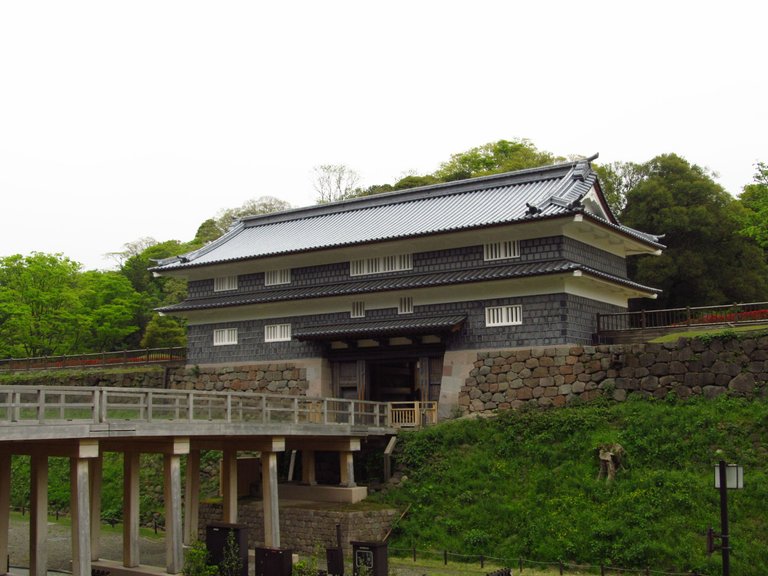
Then you would also discover this small gate, which has a much longer history than the shrine in which it stands today. While the famous main gate with its stained glass windows is often the focus of most visitors, the east gate of the shrine is a completely different story: it is an original gate from Kanazawa-Jo, the city's former castle complex, which was moved here to the shrine after the Meiji Restoration. It is an original and authentic remnant of the castle complex and a piece of feudal history that has been transferred to a religious context here in this shrine.
And that concludes our brief tour of Oyama Shrine. Directly behind is the site of the former castle complex, where various gates and buildings have been rebuilt over the past few decades, and which is another highlight of a visit to Kanazawa. So it's best to continue on and walk through the Nezumita-mon to explore all there is to see there....