Behind High-Voltage Fences: The secret Police Bunker

Deep in a Brandenburg forest lies the GDR’s forgotten nuclear bunker: a 12,000 m² concrete tomb built for the Minister of the Interior and 200 top officials to survive World War III — for exactly three days. Once guarded by armed conscripts behind electrified fences, today it’s a moldy museum of Cold War paranoia. The secret “Project 7003” is finally fallen in despair.
 It's burning down.
In a forest near Berlin, the GDR's Ministry of the Interior maintained its top-secret nuclear bunker. Conscripts from Saxony-Anhalt and Thuringia were drafted into the Barracked People's Police to patrol behind the high-voltage fence.
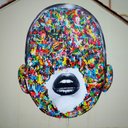
 Some artists are over painted the cold war ruins
Germany - once the proud nation of high-tech industry and global-exporting factories - now finds itself fringed by tales of what might have been: abandoned innovation parks, ruined industrial halls, and ambitious visions lost to decay.
 A barrack with camouflage net
After a few meters, the secret passage takes a bend, then continues at a right angle until a thick steel door opens, leading directly into the heart of a facility that, just three decades ago, was one of the GDR's biggest secrets. The site, codenamed "Training Facility," hidden in the dense mixed forest near the Brandenburg village of Tiefensee, conceals the nuclear fallout shelter of Friedrich Dickel, the long-serving GDR Minister of the Interior, listed in the GDR government's records as "Project 7003."
 The "Block" - under the cellar, is the door to the underground
High-Voltage fences
Everything that lies openly in the open today, behind the remnants of the former high-voltage fence, was a state secret until the end of 1989. Richard Sorge isn't broadcasting from Tokyo here – the hero from the GDR era adorns the wall of the historical museum. These are silent witnesses to a history full of traces of the past.
 Fresh air for the bunker
Conscripts from Saxony-Anhalt and Thuringia were primarily drafted for guard duty around the approximately 200-hectare complex. They were forbidden from leaving their barracks, hidden ten kilometers away in the forest. Operating under the codename "Blumberg Training Facility," the 500-strong guard unit was part of the police orchestra.
 The backdoor
Bulky Insolators
Working in weekly shifts, the conscripts patrolled behind an electrified high-voltage fence, fully armed and – like border guards – ordered to shoot on command. Remnants of fence posts, bulky insulators, and remnants of barbed wire still hide in the undergrowth. The three new apartment blocks, which once housed the bunker administration, stand empty, as do the camouflaged barracks concealed behind another fence.
 Painting of Richard Sorge, a spy in WW2
The bunker lies beneath the two buildings designated "TO1" and "TO2," accessible via a 150-meter-long underground tunnel that begins behind a steel door in a cellar beneath the cellar of the rearmost new apartment block. The passage was once accessible only to authorized personnel with state-of-the-art chip cards.
The last commander
"The technology was developed by members of the Ministry themselves and presented at the 'Trade Fair of Tomorrow'," explains Karl-Heinz Scholz, the last commander of the Blumberg People's Police station, whose honorary title was "Dr. Richard Sorge." The man who is giving his name for the secret bunker was an famous secret soviet agent while the WW2.
 Insulator for the electric fence
In 1983, the VEB Spezialbaukombinat Schwedt (a state-owned special construction company) began the excavation work on the first bunker; three years later, the entire complex was inaugurated. The Ministry of the Interior intended to spend 330 million East German marks on the construction of the nuclear bunker.
 The socialist church of the area. The place where soldiers sworn.
In three bunker rooms with a total area of approximately 12,000 square meters – today a damp, moldy, and decaying crypt – the minister himself and around 200 high-ranking officials could have survived the outbreak of World War III, albeit only for about three days. No additional food supplies were stored, nor was there any more drinking water or fuel for the ventilation system. Moreover, the bunker was only considered safe if it had not been hit by a direct hit.
 The sports place
A former officer speaks out
According to bunker expert Paul Bergner, a former People's Police officer himself, only a fourth, larger bunker with two floors, which was still in the planning stages, would have achieved protection class A, meaning it could have withstood the pressure wave of a nuclear explosion.
 The snorkel shows that there's something else there.
For the Federal Ministry of the Interior, this was insufficient to change its own plans for protecting the constitutional bodies of the Federal Republic after reunification. Even after the government moved to Berlin, the Federal Government's primary defense bunker remained a rock bunker in the Ahr Valley. The Freudenberg site, on the other hand, was abandoned – today it's a museum full of moldy teletype machines, damp documents, Russian decontamination kits, and stripped-down relay cabinets.
 Fences everywhere
Mysterious hieroglyphs
Mysterious hieroglyphs on the barracks bear witness to its temporary occupation by a religious community; wild murals and faded signs indicating dance floors and restrooms tell of its later conquest by graffiti artists and young techno dancers.
 The Traditions-Table
Years ago, the municipality designated the front section of the once top-secret facility as a low-tax zone to attract businesses to the site of the bunker ruins. So far, it's been a success, according to Freudenberg AG.
 Nature is coming back
 Camouflage against the enemies
 Rusty barbered wired fence
 Flower at the appeal square
 Inside the bunker
 A rotten antenna
 The underground map
 Electricity fence

 The weather information center


You can check out this post and your own profile on the map. Be part of the Worldmappin Community and join our Discord Channel to get in touch with other travelers, ask questions or just be updated on our latest features.
Congratulations, your post has been added to the TravelFeed Map! 🎉🥳🌴
Did you know you have your own profile map?
And every post has their own map too!
Want to have your post on the map too?
- Go to TravelFeed Map
- Click the create pin button
- Drag the marker to where your post should be. Zoom in if needed or use the search bar (top right).
- Copy and paste the generated code in your post (any Hive frontend)
- Or login with Hive Keychain or Hivesigner and click "create post" to post to Hive directly from TravelFeed
- Congrats, your post is now on the map!
PS: You can import your previous Pinmapple posts to the TravelFeed map.Opt Out
Congratulations @koenau! You received the biggest smile and some love from TravelFeed! Keep up the amazing blog. 😍 Your post was also chosen as top pick of the day and is now featured on the TravelFeed front page.
Thanks for using TravelFeed!
@for91days (TravelFeed team)
PS: TravelFeed is in social media to reach more people, follow us on Facebook, Instagram, TikTok, and X.