The Path of No Return
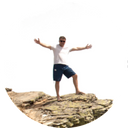
(Edited)
There are walks for the soul, and then there are walks that test your instinct of self-preservation.
When we first arrived in the village of Monodendri, everything looked like something from a postcard: neat stone houses, quiet little streets, and an old monastery perched dramatically on the very edge of the gorge. The evening had just begun, there was still about an hour before sunset, and I suggested to my wife that we take a short walk to the monastery. The plan seemed perfectly simple and logical: admire the gorge, work up an appetite, and return to the village in time for dinner.
The monastery itself turned out to be a peaceful and rather secluded place. What few people mention, however, is that just beyond it begins what the locals modestly call the path — and what some grey-haired tourists refer to as the path of no return.
The trail is carved directly into the sheer rock face. Narrow and uneven, it feels less like a hiking trail and more like a test of courage disguised as an innocent walk. There are no railings, no safety cables, nothing at all. Just rock under your feet, the cliff above your head, and several hundred meters of empty space dropping away into the green depths of the gorge.

At first, everything seemed perfectly harmless. We left the village, walked down to the monastery, passed it, and continued along what looked like a perfectly ordinary, well-worn path hugging the side of the cliff.


Gradually the path grew narrower until it turned into a thin stone ledge — a kind of natural balcony hanging over the abyss. I don't normally have a fear of heights, but at some point I noticed that my knees had started developing a life of their own, trembling slightly with every step.


My wife moved forward pressed so tightly against the rock that, given a little more time, the cliff might have started molding itself to her silhouette. She said nothing, taking small careful steps and doing her best not to look down. I kept quiet as well, staying close enough to grab her hand at any moment.
Eventually we reached a small ledge where the path turned around a corner of the cliff. We peered around it — and were momentarily stunned. The trail became even narrower there, partly eroded by rain and small landslides, and disappeared somewhere along the wall of the canyon.

I had always thought the scariest thing about heights was looking down. As it turns out, it's much worse to keep walking forward knowing that sooner or later you will have to come back the same way. But adrenaline is a tricky thing, and we kept going.

The rock hung over this improvised gallery, and the occasional handhold looked suspiciously smooth and not particularly reliable. My wife had just announced that she was not going any farther… when she suddenly started moving ahead with unexpected determination. I hurried after her, wondering where this sudden burst of courage had come from.
Then I saw what she had spotted.
A few tiny yellow flowers growing right on the edge of the path.
She crouched down to look at them — literally on the edge of the abyss — as if we were standing in a quiet park meadow rather than several hundred meters above a canyon. She whispered something admiring about their beauty. Well, beauty will save the world, as they say. At that moment I was almost ready to believe it. Though most likely she had simply switched off her instinct of self-preservation for a minute.

Eventually we reached a dead end. The path ahead had completely collapsed, and there was simply no way forward. They say that hermits once used this path to reach their caves along the canyon wall. Honestly, those people must have had nerves of steel.

My wife eventually remembered just how high up we were and sat down on the widest part of the rock, carefully holding one of those little flowers in her hand.

Meanwhile, I took photos, trying to capture views that were definitely worth a few sacrificed nerve cells.

When we finally made it back to the monastery, my wife announced that she urgently needed a drink. So dinner in the village came with a small but well-deserved bonus.
So if you ever find yourself at the monastery in Monodendri and decide to continue along that path, make sure to check not only your camera, but also your nerves. And it might not be a bad idea to bring a small flask of something stronger than water — you may find it even more useful on the way back.

Thank you for walking with me!
@alexanderfluke's travels
Canon 450D + EF17-40/2.8L USM, EF70-300/4.0-5.6 IS USM, EF50/1.8 STM
instagram · telegram · x
© All rights reserved
...
0
0
0.000
You can check out this post and your own profile on the map. Be part of the Worldmappin Community and join our Discord Channel to get in touch with other travelers, ask questions or just be updated on our latest features.
You have such a nice place.
Thank you for your comment 👍
...
Reading your posts really strengthens the desire to reach for something stronger %%.
So glad you caught that! 😊 I try to add some irony to my writing, though I'm never 100% sure it survives the translation into English. Thank you! 😌
...
It seems that the translator copes well with irony because I can feel it in your posts ;) And I also appreciate it.